

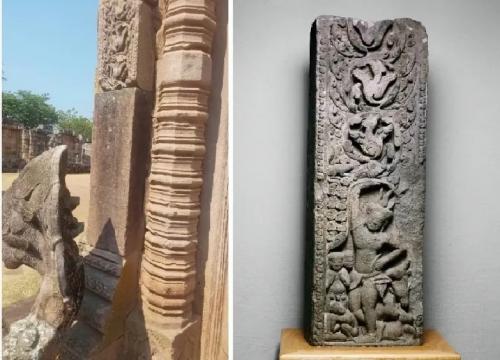
The Ministry of Foreign Affairs reported that the Art Institute of Chicago on 18 June 2024 expressed its intention to return antiquities to Thailand, including a sandstone pillar from Buri Ram.
The sandstone pillar has been verified by the Fine Arts Department of Thailand as part of a pillar on the left side of the eastern door frame of Prasat Phanom Rung, or Phanom Rung Castle, in the northeastern province of Buri Ram. It is believed to have been smuggled out of Thailand in 1965 before the restoration of Prasat Phanom Rung.
The Royal Thai Consulate-General in Chicago has played a crucial role in coordinating details with all of the parties, both the Thai and the U.S. sides, working on past and next steps in returning the artifacts safely to Thailand.
Buri Ram, one of Thailand’s lower northeastern provinces, is notable for age-old civilization, especially monuments and artifacts in the Khmer style. It borders Cambodia to the southeast. The most famous attraction that has made a name for Buri Ram is the hilltop Hindu shrine of Phanom Rung, which is referred to as Prasat Phanom Rung.
Phanom Rung is recognized as the most beautiful sandstone temple in Thailand. The Khmer word “Phanom” means “hill” and the words “Phanom Rung” were derived from the ancient Khmer language, meaning “large mountain.”
This Hindu sanctuary, evidence of an old civilization, is located on the top of Khao Phanom Rung, an inactive volcano. It was left unattended and in ruins for many centuries until 1935, when the Fine Arts Department registered it and declared it a national protected archeological site.
Prasat Phanom Rung is believed to have been constructed between the 10th and 13th centuries as a shrine of worship for the god Shiva. The day that attracts the highest number of visitors to this sandstone temple is the day when the sun’s rays pass through the 15 portals of the sanctuary at the same instant, creating a visually stunning effect. This phenomenon is rare and amazing, and it testifies to the superb skills of the temple builders.
 Image




Foreign Affairs Office, The Government Public Relations Department
9 Rama VI Road, Bangkok 10400, Thailand
Tel : (+66) 2618 2323


