


The Cabinet on 13 May 2025 approved in principle the issuance of Government Token, known in short as G-Token, as a new tool for the Government’s loan raising by adopting financial technology to provide an alternative to the public’s bond investment.
The decision was made following a proposal by the Ministry of Finance, in accordance with Section 10 of the Public Debt Management Act, B.E. 2548 (2005) and in response to the Government’s efforts to promote public access to high-quality investment opportunities and develop Thailand’s digital economy in moving toward becoming a digital society.
The Ministry of Finance needs to urgently seek loans to offset the budget deficit for the 2025 National Expenditure. Deputy Prime Minister and Minister of Finance Pichai Chunhavajira explained that G-Token is a new form of “digital asset bond,” saying that it would be the first time for the public sector to offer this new channel to raise funds directly from the public.
He said that G-Token is a digital asset with financial stability. It is not a cryptocurrency and cannot be used to replace cash or to buy products, or as a tool for payment. It is not printing new money. People may start with low investment, such as 100 or 1,000 baht, and they would have a better return than depositing money in a bank.
Mr. Pichai stated that G-Token would be well managed to ensure that the system is secure and transparent and could be traded through the digital system of the existing capital market. The Ministry of Finance will initially issue digital investment tokens worth about five billion baht.
He pointed out two major objectives for the issuance of G-Token; one is to introduce the Government’s innovative financial instrument to raise funds from the public, and the other is to provide an opportunity for all groups of people, especially those with low investment capability, to have access to additional investment options.
 Image
Image 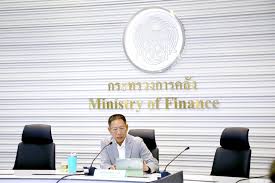



Foreign Affairs Office, The Government Public Relations Department
9 Rama VI Road, Bangkok 10400, Thailand
Tel : (+66) 2618 2323


