


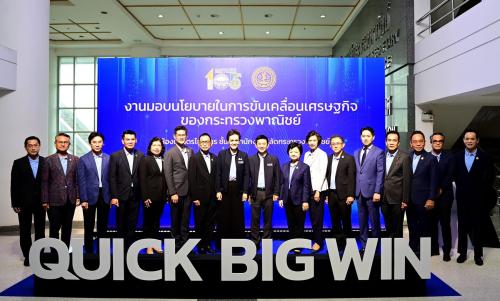
Minister of Commerce Suphajee Suthumpun has outlined her seven policies, under the “Quick Big Win” framework, to boost the Thai economy and build a firm and sustainable foundation for Thailand.
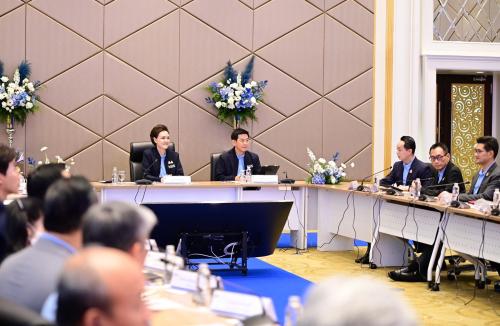
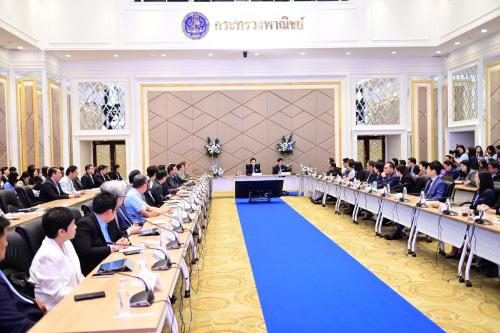
Minister Suphajee on 1 October 2025 chaired a meeting to brief her policies to the Ministry of Commerce’s executives, and the meeting was also held via an online platform for officials at commerce offices across the country and at offices of commercial affairs, under Thai embassies overseas.
The seven priority areas for rapid implementation are as follows:
1. US tariffs and trade negotiations – The Agreement on Reciprocal Trade (ART) with the United States will be finalized by December 2025. In this regard, the Rules of Origin will be improved and the issuance of Certificates of Origin will be fully digitized to prevent false claims and increase transparency;
2. Thai-Cambodian cross-border trade – Assistance will be provided for local people and traders in seven provinces sharing borders with Cambodia and affected by the Thai-Cambodian border situation. Trade fairs will be held to sell low-cost products for the people, new marketing channels will be arranged, and new markets will be found for risk diversification;
3. FTAs and new markets – Negotiations of free trade agreements will be accelerated and benefits from FTAs will be used. More than 50 Thai commercial office networks worldwide will be urged to explore new markets with great potential, such as those in the Middle East, South Africa, South Asia, and ASEAN, with an emphasis on buyer-seller matching and new trade negotiation events;
4. Measures to reduce people’s cost of living – Around 1,300 “Blue Flag” trade fairs selling low-price goods will be organized each year. The Ministry of Commerce will cooperate with more than 100 private hospitals to disclose medicine prices, so that people will have options to buy medicine outside hospitals. This is expected to reduce people’s expenses by around 32.4 billion baht annually;
5. Maintaining agricultural price stability – The Ministry of Commerce will use measures to slow rice sales with low-interest credit, allow cooperatives to keep stocks, and offer financial support of 1,000 baht per rai (1,600 square meters) for farmers, covering 4.6 million families. Rice exports under the government-to-government agreement with China will be accelerated, while negotiations with Japan and Singapore will be held in order to maintain Thailand’s rice quotas. Moreover, the cultivation of higher-quality crops will be promoted to reduce risks from global competition and climatic conditions;
6. Empowering SMEs and adding value to Thai products – The ministry will support access to new markets (South Asia, the Middle East, Africa, and Latin America), develop potential with technology, provide credit support, use logo certifications to show quality standards, such as Thailand Trust Mark and Thai SELECT, and develop the MOC+ platform to provide SMEs with easier access to government support;
7. Regulatory improvement and technology use – laws and regulations that hinder business operations will be revised, and artificial intelligence (AI) will be adopted for supply-demand analysis. This will enable trade measures to keep pace with the changing situation and expand e-commerce channels for local products to enter international markets.
 Image
Image 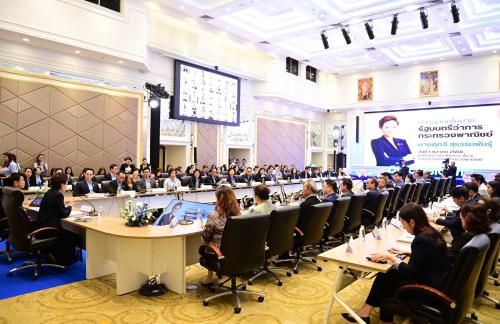






Foreign Affairs Office, The Government Public Relations Department
9 Rama VI Road, Bangkok 10400, Thailand
Tel : (+66) 2618 2323


