


Rayong, Satun, and Tak are among 72 new cities from 46 countries included in the UNESCO’s Global Network of Learning Cities, in recognition of their outstanding commitment to making the right to education across all ages a reality for all at the local level.
Minister of Education Narumon Pinyosinwat said that the United Nations Educational, Scientific, and Cultural Organization on 4 December 2025 had welcomed Rayong, Satun, and Tak Municipality to its Global Network of Learning Cities for 2025.
Mrs. Narumon stated that the recognition by UNESCO reflected a significant step for Thailand’s advancements in driving the policy of lifelong learning. She pointed out that all relevant agencies and networks have worked actively in upgrading the country’s education and promoting learning among the people of all age groups. In this regard, both formal and non-formal education systems have been developed in response to social changes in the 21st century. Each of the three cities has its unique strengths.
Rayong, an industrial province in eastern Thailand, promotes lifelong learning to address economic change, environmental challenges, and the needs of a large migrant workforce.
Satun, a coastal southern province on the Andaman Sea bordering Malaysia, is home to Thailand’s first UNESCO Global Geopark. Its economy combines agriculture, fisheries, and tourism, while diverse Thai, Chinese, Malay, Urak Lawoi, and Maniq communities contribute to a rich cultural identity.
Tak Municipality is located along the Ping River in northern Thailand and has a population of just under 15,000 residents. Cultural activities and traditional crafts play an important role in community learning and local skill development.
Mrs. Narumon said that the joining of the three cities in the UNESCO’s Global Network of Learning Cities would provide them with more knowledge and best practices from learning cities worldwide. They would also have greater opportunities for working with international networks in developing learning innovations.
She quoted UNESCO as saying that UNESCO Learning Cities are dynamic communities where learning is embedded in everyday life – across schools, workplaces, libraries, homes, and public spaces. They create opportunities for all: reskilling and upskilling workers to meet evolving job markets, providing literacy for those who missed out in early years, empowering citizens of all ages to navigate and shape the AI era, and fostering entrepreneurial mindsets.
 Image
Image 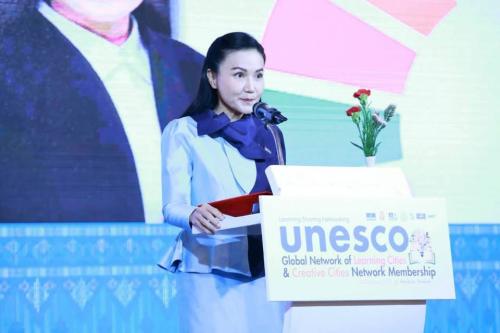




Foreign Affairs Office, The Government Public Relations Department
9 Rama VI Road, Bangkok 10400, Thailand
Tel : (+66) 2618 2323


