


Prime Minister and Minister of Interior Anutin Charnvirakul has instructed all ministries to intensify Nipah virus surveillance and preventive health screening as precautionary measures. According to the Department of Disease Control, no cases of Nipah virus infection have been reported in Thailand.
Government Spokesperson Siripong Angkasakulkiat stated that the Prime Minister also gave orders for the preparedness of public health system, including personnel, medical supplies, and response strategies for potential future outbreaks. Risk assess and management is also carried out through close coordination with the World Health Organization (WHO) and relevant international agencies to appropriately increase surveillance measures, if needed.
In an effort to prevent the infection, the Ministry of Public Health has stepped up screening measures for passengers arriving from West Bengal, India, following reports of a Nipah virus outbreak in the area. The airport screening has been carried out since 24 January 2026 at three international airports, namely, Suvarnabhumi, Don Mueang, and Phuket. Each day, about 700 passengers arrive at the three airports from West Bengal.
Meanwhile, the Phuket Provincial Public Health Office denied news reports on the social media that Indian nationals were infected and placed in quarantine in a hospital there. Strict health screening and monitoring remain in place in Phuket. The private hospital mentioned in the social media reports is preparing to take legal action against those responsible for the reports, which tarnish the image of the province.
Although Thailand is currently free from the Nipah virus outbreak, the Government has continued to closely monitor the situation. The Ministry of Education also issued guidance for preventing Nipah virus infection to ensure safety for students, teachers, and other educational personnel.
Nipah virus infection is classified as dangerous communicable disease under the Communicable Disease Act B.E. 2558 (2015), which requires immediate reporting upon detection of suspected cases. It is a zoonotic illness that is transmitted to people from animals, and can also be transmitted through contaminated food or directly from person-to-person.
In order to protect themselves from the disease, members of the public are encouraged to follow basic health practices, such as regular handwashing, staying informed through official channels, and avoiding contact with carrier animals or travel to areas where the outbreaks occur.
 Image
Image 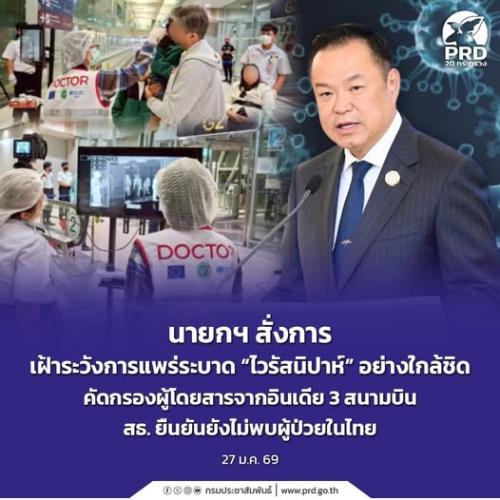




Foreign Affairs Office, The Government Public Relations Department
9 Rama VI Road, Bangkok 10400, Thailand
Tel : (+66) 2618 2323


