


All eyes are focusing on the general election and the constitutional referendum in Thailand, which are scheduled to be conducted simultaneously on 8 February 2026.
In the general election, each Thai voter will be provided with two ballots: a green one for voting for constituency MP candidates and a pink one for party list MP candidates. Out of the 500 members of the House of Representatives, 400 come from the election on a constituency basis and 100 from party lists of political parties.
Voters will also be provided with another ballot in a yellow form for the constitutional referendum to decide whether a new constitution should be created or not. They will be asked if they agree that a new constitution should be written. There will be three choices – “agree,” “not agree,” or “no comment.”
The period of voting is between 08.00 and 17.00 hr, with counting beginning immediately after polls close and conducted in public view at polling stations. There are more than 52.9 million eligible voters, and more than 126,000 police officers deployed to safeguard 99,538 polling stations across the country.
Fifty-seven political parties have fielded candidates to contest this general election, while 43 parties have nominated 93 prime ministerial candidates. Major political parties running in this general election include Bhumjaithai, Pheu Thai, People’s Party, Palang Pracharath, Democrat, Klatham, and United Thai Nation.
Bangkok has the greatest number of constituencies, followed by Nakhon Ratchasima, Khon Kaen, Ubon Ratchathani, Chiang Mai, Chon Buri, Buri Ram, Udon Thani, Songkhla, Nakhon Si Thammarat, and Si Sa Ket.
A temporary nationwide ban on the sale, distribution, and serving of alcoholic beverages will be imposed from 18.00 hr on Saturday, 7 February, until 18.00 hr on Sunday, 8 February, after polls close.
 Image
Image 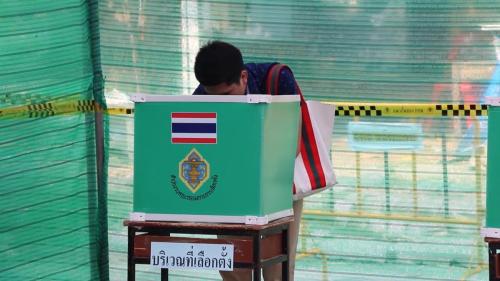




Foreign Affairs Office, The Government Public Relations Department
9 Rama VI Road, Bangkok 10400, Thailand
Tel : (+66) 2618 2323


