


The Joint Management and Monitoring Center for the Situation in the Middle East on 17 March 2026 held a press briefing to explain the Government’s measures to manage energy supply, the cost of living, and economic impacts.
The briefing was attended by Mr. Piphat Ratchakitprakarn, Deputy Prime Minister and Minister of Transport; Mr. Auttapol Rerkpiboon, Minister of Energy; Mrs. Suphajee Suthumpun, Minister of Commerce; and Mr. Danucha Pichayanan, Secretary-General of the National Economic and Social Development Council (NESDC).
Mr. Piphat Ratchakitprakarn said that key conclusions were reached by relevant agencies on how to manage oil prices after the 15-day diesel price cap ended on 17 Match. The Government would expand price announcements to cover retail prices at service stations, refinery gate prices, and depot prices to ensure clearer transparency at all levels. It would also promote alternative diesel fuels, expanding from B7 to B10 and B20. B20 will mainly be distributed through wholesale channels to support the industrial, transport, agricultural, and construction sectors.
Promoting B10 and B20 will not only help manage energy use but also support biodiesel consumption and stabilize agricultural prices, especially palm oil, which is expected to reach peak production in the next four to six months. Higher use of B10 and B20 will help keep palm oil prices more stable.
Mr. Auttapol Rerkpiboon said that on the supply side Thailand has secured additional crude oil sources outside the Middle East. Over the past two to three days, about 2 million barrels of crude oil from Angola and another 700,000 barrels from the United States have been confirmed. Thailand, therefore, has oil reserves sufficient for no less than 101 days.
He added that all Thai refineries are operating at full capacity, with some running above normal levels to meet the rising fuel demand. At the same time, major oil traders under Section 7 are cooperating by keeping oil depots open 24 hours a day, seven days a week, allowing tanker trucks to collect and distribute fuel nationwide without interruption.
However, the main challenge is now at the distribution stage, especially the limited number of oil tanker trucks. These vehicles must meet strict safety standards and cannot be increased quickly in the short term. In addition, public concern in recent days has led many people to refuel more than usual, causing sales at some stations to nearly double on certain days. As a result, the transport cycle has not been sufficient to meet demand.
The Ministry of Energy has, therefore, discussed with oil traders the possibility of easing some regulations, such as extending the allowable age of tanker trucks entering depots and simplifying inspection procedures. The ministry has also asked for cooperation from the Ministry of Interior, the Ministry of Transport, the Bangkok Metropolitan Administration, and the Royal Thai Police to consider temporarily easing traffic restrictions for oil tanker trucks to improve nationwide fuel distribution.
Mr. Auttapol also said that the Government will raise the ceiling price of B7 diesel from not more than 30 baht per liter to not more than 33 baht per liter. The increase will be gradual to reduce the impact on the public and on product prices. The first step will begin on 18 March with an increase of 0.50 baht per liter. This adjustment reflects market conditions and is considered a moderate level that should not create excessive burdens.
He noted that the level of 33 baht per liter is not higher than prices seen during some periods in previous years and is close to diesel prices in neighboring countries. The Ministry of Energy will also promote biofuels by setting the price of B10 at 2 baht per liter, lower than B7, and B20 at 5 baht per liter, lower than B7, to encourage wider use of biofuel blends.
As for gasoline, the ministry will promote greater use of E20 fuel. Starting on 18 March, E10 gasoline will increase by 1 baht per liter while E20 will decrease by 0.79 baht per liter, making E20 cheaper than E10 by up to 5 baht per liter. This pricing policy aims to encourage consumers to shift to fuels with higher ethanol content, reducing dependence on fossil fuels while supporting the agricultural sector.
Mrs. Suphajee Suthumpun said the Ministry of Commerce recognizes that global energy price volatility has created concerns among the public and businesses across many sectors. However, because diesel prices are still kept at levels not higher than last year, prices of consumer goods and essential products remain manageable and should not yet need adjustment.
She added that eight controlled goods must receive approval from the Department of Internal Trade before any price increase. These include instant noodles, canned food, powdered milk, chemical fertilizers, pesticides, and animal feed. So far, no operators have submitted requests to increase prices. Another group of products, such as laundry detergent, liquid detergent, shampoo, and dishwashing liquid, must notify authorities in advance if prices are to be raised, and no notifications have been submitted.
The ministry is closely monitoring prices through the Central Committee on Prices of Goods and Services and provincial monitoring teams. Provincial governors, deputy governors, provincial commerce offices, and provincial energy offices are working together as local task forces. The ministry has also asked the public and the media to report any unfair price increases through hotline 1569 so officials can quickly investigate and take action.
Mrs. Suphajee added that the Ministry of Commerce is preparing proactive measures to help reduce the cost of living. These include cooperation with major manufacturers and nationwide wholesale and retail operators to distribute special-price goods across all provinces. The Blue Flag program will also be expanded in vulnerable areas to directly reduce the burden on the public. The ministry is also preparing measures to address possible increases in production costs, especially chemical fertilizers. Current domestic stocks are sufficient until May, and together with shipments already on the way they will be sufficient until August, despite current transport limits from the Middle East. Concerning plastic resin, an important raw material for food packaging, the ministry reports that domestic supply is sufficient for about four months. Discussions are ongoing with industry operators to find alternative import sources from other countries to reduce future cost risks.
Mr. Danucha Pichayanan said that early assessments during the first week show that the impact on Thailand’s GDP remains within the previously projected range. However, as the situation continues to change, the NESDC has developed three possible scenarios to assess future economic impacts.
The first scenario assumes the conflict remains limited within the Middle East and ends within one month. Disruptions to transport through the Strait of Hormuz would be short-term. Average crude oil prices for the year would range between 75 and 85 US dollars per barrel, with inflation rising to about 1 percent.
The second scenario assumes the situation continues for about three months and oil production and transport in the region face greater limits. This could slow the global economy, with several countries entering recession and facing higher inflation. Under this scenario, average crude oil prices could range between 95 and 105 US dollars per barrel, while Thailand’s inflation could rise to about 1.9 percent.
The third scenario involves a full-scale war that would affect all countries, including Thailand. The NESDC is conducting deeper assessments on impacts to the global economy, trade volumes, and Thailand’s economy before presenting findings and additional measures through the proper process.
Mr. Danucha added that the main impacts currently seen are in the agricultural sector, manufacturing, and transportation. Relevant agencies have already begun initial support measures. The NESDC is also preparing additional policy options in case the situation lasts longer, especially to support vulnerable groups, the general public, small and medium-sized enterprises (SMEs), and large businesses.
The Government reaffirmed that it would closely monitor the situation and take necessary steps to ensure energy security, manage the cost of living, and address economic impacts in a comprehensive way. The public is encouraged to use energy wisely and avoid unnecessary stockpiling so that resources can be managed efficiently during the current situation.
 Image
Image 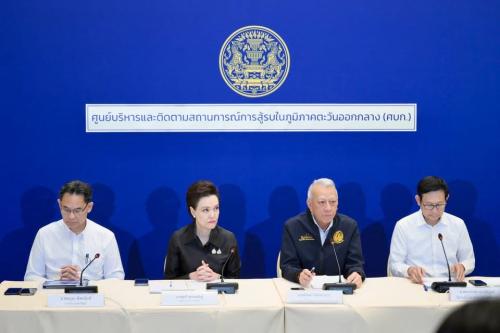




Foreign Affairs Office, The Government Public Relations Department
9 Rama VI Road, Bangkok 10400, Thailand
Tel : (+66) 2618 2323


