


The Joint Center for Management and Monitoring of the Situation in the Middle East held a press briefing on 22 March 2026 to address key questions and concerns from the public.
The briefing was delivered by Mr. Sarawut Kaewtatip, Director-General of the Department of Energy Business; Ms. Yanee Srimanee, Deputy Director-General of the Department of Internal Trade; and Mr. Panidorn Pachimsawat, Acting Director-General of the Department of Information and Deputy Spokesperson of the Ministry of Foreign Affairs.
• If oil supplies are sufficient, why are shortages occurring in some areas?
The Director-General of the Department of Energy Business explained that Thailand still has sufficient oil reserves overall, with total reserves estimated to last about 103 days. This includes 1.504 billion liters of commercial reserves, 3.389 billion liters of legally required reserves, 4.2 billion liters currently in transit, and about 3.7 billion liters already secured through procurement contracts. Production capacity also remains high: gasoline production is around 35.28 million liters per day, with sales at approximately 34.40 million liters per day. Diesel production stands at 79.9 million liters per day, exceeding normal demand of around 67–70 million liters per day.
However, he said, in recent days demand has surged unusually, at times exceeding 100 million liters per day. This sudden spike has caused distribution bottlenecks in certain areas, even though overall supply remains sufficient. On 20 March, diesel sales reached about 71 million liters per day, requiring additional supply from reserves. In response, the government has allowed fuel transport trucks to operate 24 hours nationwide and is coordinating with relevant agencies to accelerate distribution to service stations. Additional supply is also being injected into the system to ease the bottlenecks. The situation is expected to gradually stabilize within one to two weeks.
• Are there cases of hoarding or opportunistic price increases?
The Deputy Director-General of the Department of Internal Trade reported that authorities are closely monitoring both prices and supply levels. Between 1 and 20 March 2026, a total of 2,321 inspections were conducted, including visits to 2,021 establishments nationwide. These included 1,262 fuel stations, 433 fertilizer retailers, and 326 markets or wholesale and retail outlets, to ensure that products are sold at displayed prices consistent with actual costs.
The department also received 300 complaints via the 1569 hotline – 53 in Bangkok and 247 from other provinces. Of these, 99 cases have been resolved. Violations found included 12 cases of failure to display prices and 3 cases of selling at prices different from those displayed, with legal action taken accordingly. Another 201 cases remain under investigation.
Additionally, 25 complaints related to excessively high prices are currently under review based on cost structures. The Ministry of Commerce has also implemented proactive measures to reduce the cost of living, including expanding “Blue Flag” low-cost product outlets, establishing a nationwide network to share locations of affordable goods, and preparing assistance measures for vulnerable groups such as farmers and low-income households. Programs to reduce fertilizer prices and other agricultural inputs during the planting season, including the “Green Flag” Program, are also being implemented. Authorities reaffirmed that strict action will be taken against any attempts to exploit the situation through unjustified price increases.
• How does the Middle East situation affect Thai citizens, and what precautions should be taken?
The Acting Director-General of the Department of Information and Deputy Spokesperson of the Ministry of Foreign Affairs stated that the situation in the Middle East has remained intense into its fourth week, with attacks expanding to energy infrastructure in several countries, affecting global economic stability. Tensions also remain high in the Strait of Hormuz, although multiple countries are working to restore normal maritime navigation.
The Ministry of Foreign Affairs, therefore, advises Thai citizens to avoid travel to high-risk areas, closely follow updates from Thai embassies, record emergency contact numbers, download the Thai Consular mobile application to contact authorities for assistance in emergency situations, and strictly comply with the laws and regulations of the host country.
Regarding assistance for Thai nationals in the region, the government continues to provide support. One Thai worker in Israel has been confirmed deceased, and arrangements are being made to return the body to Thailand. Evacuations of Thai workers and students from high-risk areas are ongoing. To date, a total of 1,475 Thai nationals have been assisted in leaving affected areas.
The Government reaffirmed that it will continue to closely monitor the situation and provide full assistance to Thai citizens abroad. The public is encouraged to remain calm, continue daily activities as normal, use energy responsibly, and follow official information from the Government.
 Image
Image 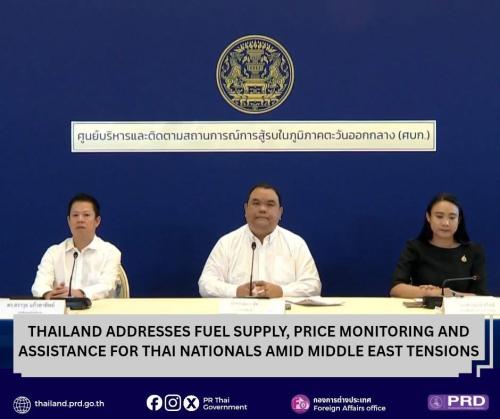




Foreign Affairs Office, The Government Public Relations Department
9 Rama VI Road, Bangkok 10400, Thailand
Tel : (+66) 2618 2323


