


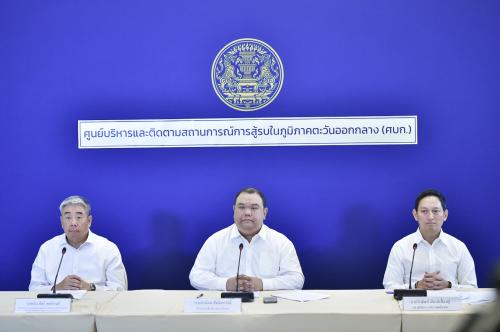
The Joint Management and Monitoring Center for the Situation in the Middle East held a press briefing on 30 March 2026 at 11.05 hr on the Middle East situation and Thailand’s measures to address issues concerning energy and the cost of living.
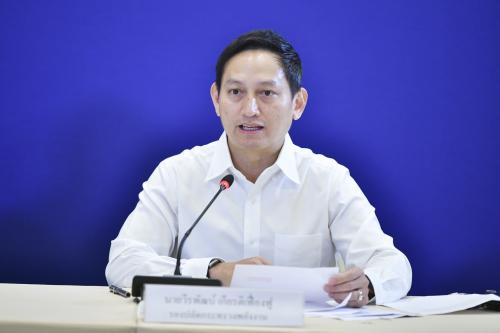
At the press briefing, Mr. Panidone Pachimsawat, Acting Director-General of the Department of Information and Deputy Spokesperson of the Ministry of Foreign Affairs, explained that tensions in the Middle East have intensified following Iran’s seizure of vessels associated with certain countries in the Strait of Hormuz, while the Houthi group in Yemen has declared its participation in the conflict. These developments directly affect maritime safety in the Red Sea and the Bab el-Mandeb Strait.
He said that although some Thai commercial vessels have already been able to safely pass through the Strait of Hormuz, the situation remains highly uncertain. The Joint Management and Monitoring Center for the Situation in the Middle East, therefore, approved the establishment of an integrated task force to assist Thai cargo vessels still stranded in the area to depart safely and in an orderly manner, while also intensifying communication with international partners.
Mr. Weerapat Kiatfueangfoo, Deputy Permanent Secretary of the Ministry of Energy, reported that global oil markets remain highly volatile. Dubai crude prices on 27 March stood at more than USD 120 per barrel, an increase of 72 percent compared with the period prior to the conflict. Meanwhile, refined diesel prices have surged to more than USD 200 per barrel, at one point reaching USD 240 per barrel, more than double previous levels.
In Thailand, the retail diesel price remains at 38.90 baht per liter, an increase of only 30 percent, supported by contributions from the Oil Fuel Fund amounting to 4.05 baht per liter (up 34 percent). This remains lower than increases seen in neighboring countries, such as Malaysia where diesel prices rose 50 percent to 45.41 baht per liter, as well as in Vietnam, the Philippines, and the Lao PDR where increases range between 10–50 percent.
To help reduce costs, the Ministry of Energy is also promoting the use of B20 diesel, which is priced 5 baht per liter lower. The fuel is already available at service stations operated by PTT and PTG.
Concerning measures to help ease the financial burden on the public, Mr. Prakhan Kodamrong, Minister (Commercial), Permanent Representative of Thailand to the WTO and the World Intellectual Property Organization (Bangkok Office), stated that the Ministry Commerce will launch the “Thai Helps Thai” campaign nationwide on 1 April 2026, offering discounts of up to 50 percent on more than 1,000 products. Over 500 “Blue Flag” low-price outlets and mobile distribution units will begin operating in remote areas in April. In addition, special-price raw materials will be supplied through Bangkok wholesale markets to help reduce costs for local food vendors.
The Ministry of Commerce will launch the “Green Flag Fertilizer Plus” project, extending the existing discount of 200 baht per sack of chemical fertilizer for up to five sacks, totaling 1,000 baht per farmer. Thai commercial counsellors worldwide have also been instructed to seek alternative fertilizer import sources.
 Image
Image 




Foreign Affairs Office, The Government Public Relations Department
9 Rama VI Road, Bangkok 10400, Thailand
Tel : (+66) 2618 2323


