


Government Spokesperson Rachada Dhnadirek has clarified Thailand-Myanmar relations, stating that the Government attaches great importance to maintaining relations and cooperation with neighboring countries and that Thailand’s ties with Myanmar are intertwined across economy, security, environment, and energy.
Referring to concerns by an opposition party over the Government’s welcoming President of Myanmar U Min Aung Hlaing during his recent official visit to Bangkok, the Government Spokesperson defended the diplomatic move. She said that fostering good neighborliness is a key mechanism for strengthening stability, safeguarding security, and elevating the quality of life for the Thai people.
Responsible politics, she said, should allow people to see all aspects of the facts regarding the country's problems, benefits, and opportunities. Many problems involve transboundary issues that require Thailand to cooperate with its neighbors, as they cannot be resolved alone.
These issues include, for example, drug suppression and control, transnational crime, particularly scam operations, and transboundary pollution, such as forest fires and PM 2.5 particles.
The Government Spokesperson said that Thai-Myanmar energy cooperation has played a vital role in strengthening energy security and managing production costs for the country. Minister of Energy Akanat Promphan, together with representatives of relevant agencies, recently met with Mr. Ko Ko Lwin, Minister of Electricity and Energy of Myanmar, to discuss natural gas exploration and production, gas trading, and electricity grid interconnection.
Myanmar has been one of Thailand’s key sources of natural gas for almost 40 years. Gas from the Yadana and Zawtika fields once accounted for 15–20% of Thailand’s total natural gas demand. These supplies have been crucial for electricity generation, industry, and economic activity, making continuous cooperation between the two countries essential.
She said that having sufficient, continuous, and diversified energy sources enables Thailand to better manage energy risks and costs. Ultimately, this directly impacts electricity prices, production costs, and Thailand’s economic competitiveness, while also contributing to ASEAN’s long-term energy security.
 Image
Image 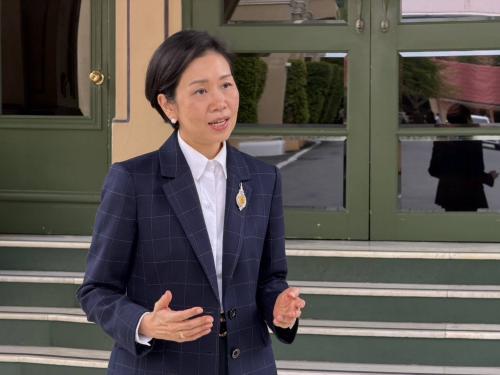




Foreign Affairs Office, The Government Public Relations Department
9 Rama VI Road, Bangkok 10400, Thailand
Tel : (+66) 2618 2323


