


Three global rating agencies – Fitch, Moody’s, and S&P – give Thailand a stable economic outlook, reflecting growing confidence in the country’s economic stability, political certainty, and policy continuity.
Deputy Government Spokesperson Lalida Persvivatana stated that Fitch Ratings has revised Thailand’s sovereign credit rating outlook from negative to sable and affirmed its BBB+ rating, effective on 18 September.
Moody's had upgraded Thailand’s credit outlook from negative to stable, while affirming Thailand’s sovereign credit rating at Baa1in April 2026, whereas S&P recently affirmed Thailand's sovereign credit rating at BBB+ and maintained a stable outlook, citing confidence in the country's economic fundamentals, external financial position, and policy direction.
Fitch expects that Thailand's economy will grow by 2.3 percent in 2026, compared with 2.4 percent in 2025. The growth rate is driven by artificial intelligence (AI)-related investment and growing domestic consumption.
Fitch also expects general government debt to stabilize by the 2028 fiscal year (starting 1 October 2027) at just below 63 percent, up from 59.3 percent in the 2025 fiscal year (“BBB” median: 57 percent). When it revised the outlook to negative in September 2025, it forecast general government debt to stabilize at just under 65 percent of GDP, but the 2025 fiscal year outcomes in Government Finance Statistics (GFS) terms have been stronger than expected and nominal growth is higher as inflation has picked up.
Fitch believes that Thailand’s current account will return to a surplus of 1.5% in 2027. Thailand also maintains a strong external financial position.
Ms. Lalida said that the Government would continue to attract new investments, especially in future industries, such as AI data centers, advanced technology, and clean energy, while developing labor skills, generating quality employment, and increasing people’s income. At the same time, it will maintain a balance between economic drive and fiscal discipline.
 Image
Image 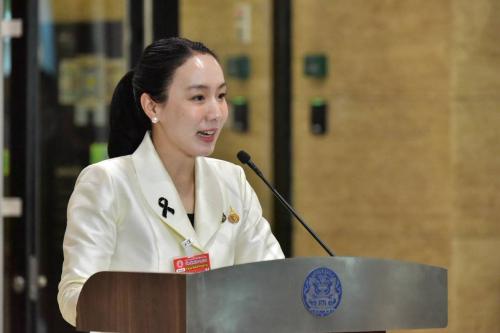




Foreign Affairs Office, The Government Public Relations Department
9 Rama VI Road, Bangkok 10400, Thailand
Tel : (+66) 2618 2323


