


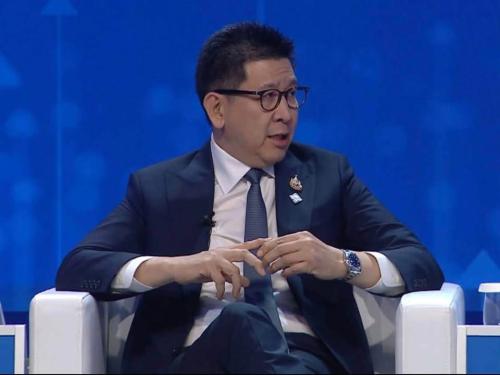
Deputy Prime Minister and Minister of Finance Ekniti Nitithanprapas stated that global economic fragmentation is shifting business priorities from efficiency to security and risk diversification, and that Thailand must remain open to trade, investment, and international rules while diversifying risks and maintaining strategic autonomy to strengthen economic resilience.
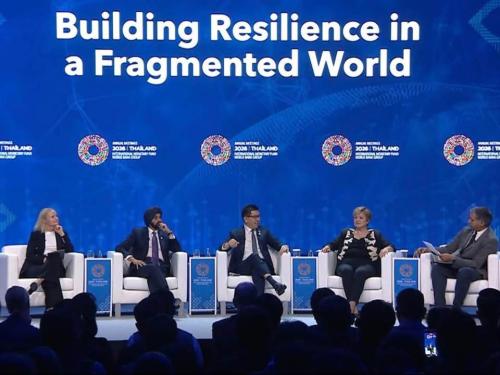
Speaking on 13 October at the high-level discussion titled “Building Resilience in a Fragmented World” during the 2026 IMF–World Bank Group Annual Meetings at the Queen Sirikit National Convention Center in Bangkok, Mr. Ekniti identified three main channels through which fragmentation affects economies: trade and essential goods, short-term capital flows, and long-term foreign direct investment relocation.
He noted that Thailand imports approximately 50% of its energy from the Middle East and has sought alternative sources in West Africa and Latin America over the past seven to eight months. Diversifying trading partners, energy sources, markets and technologies can reduce dependence on any single source, while creating opportunities to expand exports, attract investment and learn new technologies.
Thailand’s applications for investment promotion increased by 47% in the first half of 2026, while private investment grew by more than 10% for two consecutive quarters. The Government is working to sustain investment momentum and turn investment interest into tangible economic activity.
Mr. Ekniti emphasized Thailand’s potential to serve as a “Trusted Connector,” linking markets, capital, technology, and people across countries through reliable rules and transparent, verifiable standards. The benefits of these connections must reach domestic small and medium-sized enterprises (SMEs) and local communities. ASEAN can serve as a network of Trusted Connectors linking energy, food, manufacturing, logistics, finance, digital services, healthcare and skills development, while Thailand can also build practical partnerships with medium-sized economies outside the region.
He also outlined four key transformations for Thailand: diversifying markets and supply chains in response to geopolitical shifts; using artificial intelligence (AI) to boost productivity and participate in the AI value chain; reducing dependence on imported energy while strengthening climate adaptation; and building long-term savings while harnessing opportunities in the longevity economy as the population ages.
 Image
Image 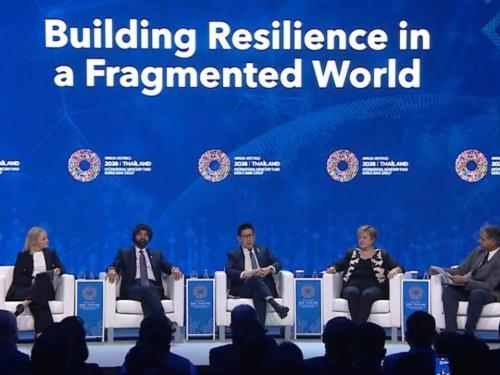





Foreign Affairs Office, The Government Public Relations Department
9 Rama VI Road, Bangkok 10400, Thailand
Tel : (+66) 2618 2323


