


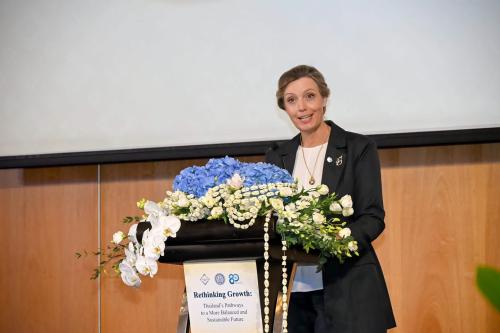
Ms. Michaela Friberg-Storey, United Nations Resident Coordinator in Thailand, has commended Thailand’s practical pathways to sustainable development, particularly its application of the Sufficiency Economy Philosophy (SEP), as an example of how national development approaches can contribute to advancing the Sustainable Development Goals (SDGs) globally.
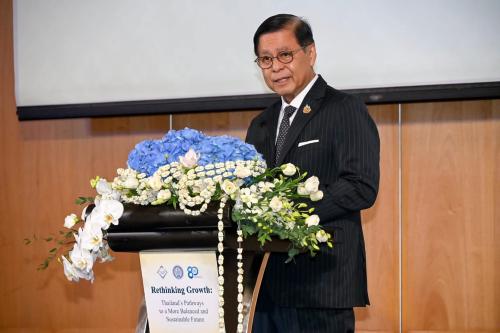
At the Dinner Talk on the topic “Rethinking Growth: Thailand’s Pathways to a More Balanced and Sustainable Future,” held in Bangkok on 13 October, the United Nations Resident Coordinator emphasized the importance of measuring economic progress beyond GDP, taking into account people’s well-being, inequalities reduction and environmental protection.
She called for accelerated SDG implementation through sustainable development financing and the responsible use of technology and artificial intelligence.
Organized by the Ministry of Foreign Affairs at the Sheraton Grande Sukhumvit Hotel, the Dinner Talk was part of the affiliated program during the 2026 Annual Meetings of the International Monetary Fund and the World Bank Group. It was attended by the Deputy Prime Minister of the Russian Federation and representatives at the ministerial-level from Singapore, Curaçao, and Côte d’Ivoire, as well as the United Nations Development Programme Administrator and the UN Resident Coordinator in Thailand.
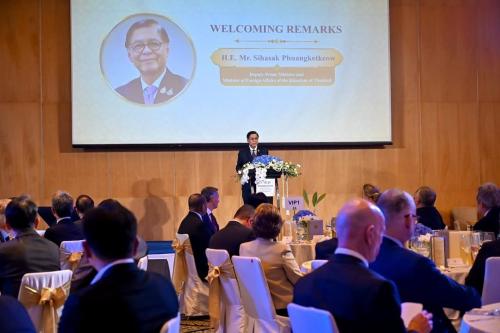
In his welcoming remarks at the Dinner Talk, Deputy Prime Minister and Minister of Foreign Affairs Sihasak Phuangketkeow highlighted the challenges of achieving the SDGs by 2030 amid ongoing geopolitical tensions.
He underscored that finding pathways toward sustainable development begins at home with each country making choices based on its own national context and priorities. For Thailand, the SEP serves as a guiding approach to advancing the SDGs, emphasizing balanced and resilient development that leaves no one behind and takes into account the well-being of future generations.
The Deputy Prime Minister further stressed that slow progress toward the SDGs should not deter the international community from sustaining its efforts beyond 2030, as eradicating poverty, expanding opportunities, and protecting the environment remain long-term priorities that require continued collective action.
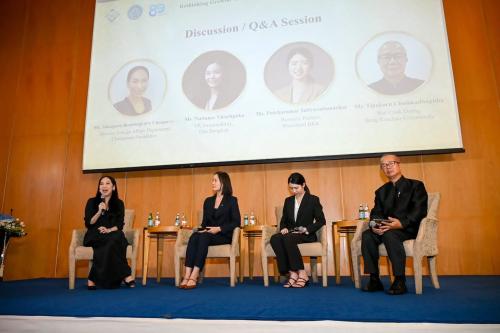
According to the Ministry of Foreign Affairs, the event featured a presentation by a representative of the Chaipattana Foundation on the linkages between the SEP, the Bio-Circular-Green (BCG) Economy Model and the SDGs. A panel discussion by representatives from One Bangkok, Wasteland BKK and Wat Chak Daeng showcased practical applications of these approaches through their sharing of experiences in sustainable urban development, resource efficiency for small businesses, and community-based waste management.
 Image
Image 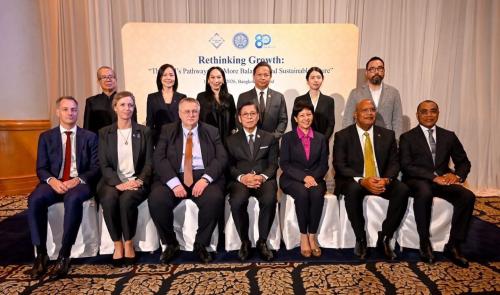




Foreign Affairs Office, The Government Public Relations Department
9 Rama VI Road, Bangkok 10400, Thailand
Tel : (+66) 2618 2323


