

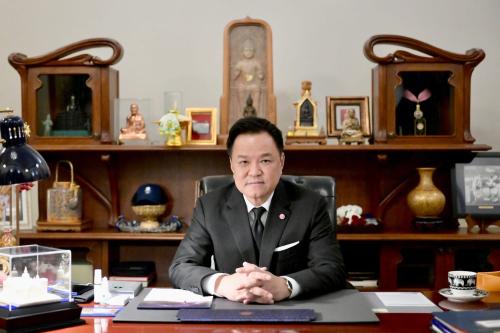
On the occasion of this year’s United Nations Day, Prime Minister Anutin Charnvirakul has reaffirmed Thailand’s commitment to actively and constructively cooperate with the global community to uphold the United Nations’ aspirations of building a world of peace and promoting sustainable development for a better quality of life for all peoples.
In his remarks on the United Nations Day, 24 October 2026, the Prime Minister stated that, today, geopolitical conflicts, climate change, and advances in technology and artificial intelligence are posing new challenges to the world and often testing the strength of the international order.
“Thailand is committed to the principles of sovereignty and equality of all countries as well as the peaceful resolution of disputes and respect for international law. We believe that cooperation and universally recognized rules are fundamental to peace and sustainable development,” he said.
In addition to the reaffirmation by the Thai government to these principles at the recent 81st Session of the United Nations General Assembly, Thailand has also elevated its role in coordinating global and regional cooperation in various fields.
The Prime Minister said, “The Annual Meetings of the International Monetary Fund (IMF) and World Bank Group, held in Bangkok in the middle of this month to discuss future economic outlook, serve as another concrete example of such cooperation. The meetings reinforce Thailand’s readiness to serve as a bridge, by which countries can build understanding and expand cooperation within the framework of the United Nations, bilateral relations, and multilateral forums at all levels.”
Following the Second World War, countries came together to establish the United Nations with the intention of maintaining peace, preventing the world from another large-scale war, and enabling the international community to resolve conflicts through peaceful means.
These purposes were the determination that led to the creation of the United Nations Charter, which entered into force on this day 81 years ago. Since then, international cooperation has led to the formulation of a number of shared rules applied by Member States, ranging from the protection of human rights, children and women, to labor rights, the law of the sea, and cooperation on the environment, education, culture, and sustainable development.
 Image



Foreign Affairs Office, The Government Public Relations Department
9 Rama VI Road, Bangkok 10400, Thailand
Tel : (+66) 2618 2323


