

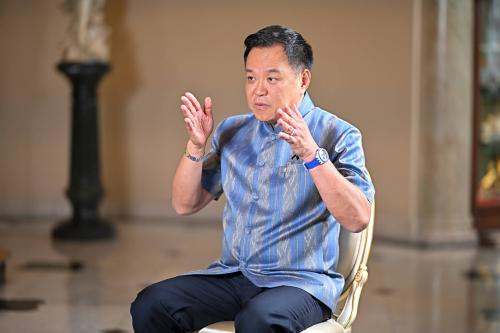
On 24 October 2026, during the televised program “Talk with the Anutin Cabinet” on the National Broadcasting Services of Thailand (NBT), Prime Minister Anutin Charnvirakul outlined key economic guidelines and trade partnerships.
He emphasized that Thailand is elevating its presence on the global stage by expanding trade partnerships and collaborating with the private sector to remove business hurdles and foster growth, while aiming to boost trade, investment, and international confidence.
The Prime Minister stated that Thailand has the potential to be a trading partner, a producer of quality goods at fair prices, and a food-secure nation, and wants partner countries to view Thailand as a partner rather than just a product seller. Therefore, meeting with leaders of various countries is a chance to present Thailand's potential and show that cooperation will bring mutual benefits in trade, investment, and new opportunities.
Regarding Thailand’s hosting of the 2026 IMF-World Bank Group Annual Meetings from 12 to 18 October, he noted that the event offered business opportunities for the country, especially within the MICE (Meetings, Incentives, Conferences, and Exhibitions) sector. Of the more than 190 participating nations, over half already have established businesses and investments in Thailand.
The Prime Minister said that foreign investment figures for the first half of the year up to June were higher than the total for the entire previous year, representing an increase of about 30 percent. Meanwhile, Thailand's exports expanded by nearly 25 percent and continued to grow month-on-month, reaching a peak this past August.
Concerning the issue of energy, the Prime Minister said that Thailand has sufficient energy for domestic consumption. Although Thailand still imports oil at the original volume, Thai people have cooperated in using energy sparingly. The Government is encouraging the public to adopt more electricity, offering financial support or incentives for individuals switching from oil or natural gas to alternative and clean energy sources.
Regarding the installation of solar rooftop power generation systems, the Government provides the opportunity to feed unused excess electricity back into the state power grid and receive payment for that sold electricity, helping to reduce electricity expenses for the public and offering households long-term income-generating opportunities. If more excess electricity enters the grid, it will also help increase the power supply for the industrial sector and public enterprises. The Government has pursued this policy continuously over the past year and has received strong interest and cooperation from the public.
 Image




Foreign Affairs Office, The Government Public Relations Department
9 Rama VI Road, Bangkok 10400, Thailand
Tel : (+66) 2618 2323


