


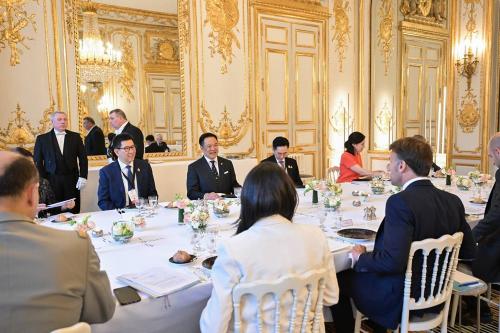
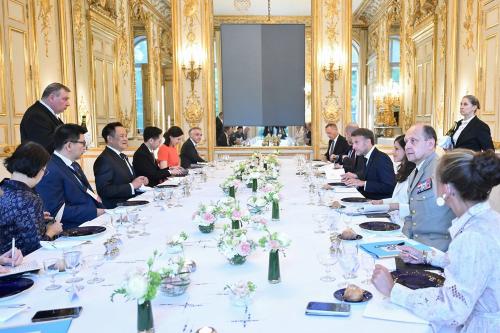
President of the Republic of France Emmanuel Macron hosted a dinner for Prime Minister and Minister of Interior Anutin Charnvirakul at Palais de l’Elysée in Paris on 25 May 2026, when they discussed the elevating of Thai-French relations to a “Strategic Partnership” and the expansion of bilateral economic and security cooperation.
Government Spokesperson Rachada Dhnadirek disclosed key issues discussed at the dinner as follows:
1. Promotion of Trade and Investment
The President of France and Prime Minister Anutin agreed to further promote bilateral trade and investment, particularly in high‑value industries, such as alternative energy, space and aviation, and smart power grids, as well as infrastructure for AI and data centers. These are future industries in which the French private sector possesses strong expertise and capacity. Following the Prime Minister’s meeting with representatives of MEDEF International and leading French companies, several firms expressed interest in investing or expanding their investments in Thailand. The French President commended the Thai private sector investments in France and expressed hope to see more Thai enterprises investing in the country.
2. Thailand-EU Free Trade Agreement (FTA)
The Thailand-EU FTA is one of the Thai government’s key policies, with a firm commitment to finalize negotiations within this year. The Prime Minister thanked France for its continued support of the negotiation process and expressed confidence that the agreement will be a turning point that creates significant economic opportunities for both countries.
3. Enhancing Security Cooperation Towards Cybersecurity
Building upon both countries’ participation in the Cobra Gold exercise, cooperation will be expanded to include security and cybersecurity. This aligns with the Government’s intention to seek global cooperation in combating scammers and online threats, which has already yielded tangible results in prosecutions, extraditions, and the seizure of illegal assets.
4. Thailand – Cambodia and Myanmar Situations
The Prime Minister reaffirmed Thailand’s adherence to the principles of sovereignty, peace, and international law. The decision to terminate MOU 44 was made because there had been no progress for almost 25 years. Thailand has, therefore, opted to rely on international law, specifically UNCLOS, in bilateral discussions. For land border issues, Thailand will adhere to the joint statement signed late last year. There is also the need to assess Cambodia’s sincerity in this process.
On this occasion, both sides agreed to implement the “Joint Action Plan to strengthen the Thai–French Partnership 2026–2028,” an important step towards elevating bilateral relations to a strategic partnership.
Participants from the French side at the dinner included Minister for Europe and Foreign Affairs Jean-Noël Barrot; Deputy Minister for Francophonie and International Partnerships Éléonore Caroit; Director‑General for Asia and Oceania Benoît Guidée; Ambassador of France to Thailand Jean‑Claude Poimboeuf; Diplomatic Advisor to the President of France Emmanuel Bonne; Advisor on Asian Affairs Julie Le Saos; Advisor on International Communications Jean‑Noël Ladois; Advisor on International Economic Affairs Victoire Vandeville; and Military Advisor to the President of France General Vincent Giraud.
 Image
Image 





Foreign Affairs Office, The Government Public Relations Department
9 Rama VI Road, Bangkok 10400, Thailand
Tel : (+66) 2618 2323


