


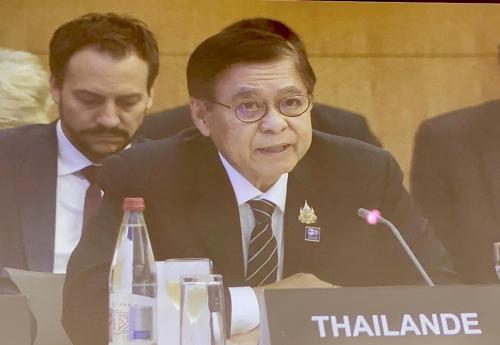
Deputy Prime Minister and Minister of Foreign Affairs of Thailand Sihasak Phuangketkeow stated that Thailand stands ready to contribute its own experiences to OECD discussions and serve as a bridge between the OECD and emerging economies.
The Deputy Prime Minister on 3 June 2026 delivered a statement during the Plenary Session on “Balancing the Goals and Impacts of Industrial Policy” at the 2026 OECD Ministerial Council Meeting (MCM) at the OECD Headquarters in Paris.
In his statement, he underscored that Thailand’s OECD accession process is an integral part of the country’s broader economic transformation. While accession would help Thailand align with international best practices and strengthen its institutions,
The Deputy Prime Minister also emphasized that while industrial policy remains important for economic development, it must evolve from supporting individual sectors to enabling economy-wide transitions that enhance competitiveness, strengthen resilience, and promote sustainable growth.
He noted that such a transition requires investment in people through skills development and lifelong learning, alongside support for innovation, digital transformation, and green technologies. He also highlighted the importance of deeper regional economic integration, as supply chains, technology, energy, and investment are becoming increasingly interconnected across borders.
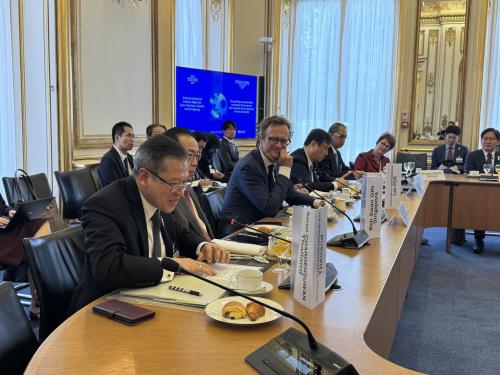
On the same day, Vice Minister for Foreign Affairs of Thailand Sarun Charoensuwan participated in the Southeast Asia–OECD Ministerial Breakfast on the theme “The Next Phase of Global Economic Integration: Southeast Asian Perspectives.” Hosted by Canada, the event brought together senior representatives from OECD member countries and Southeast Asian nations to exchange views on the future direction of the global economy and cooperation between the OECD and Southeast Asia.
The Vice Minister emphasized that economic integration in the current era should focus on maintaining a balance between resilience, security, and sustainability, while enhancing long-term competitiveness and strengthening participation in trusted and reliable regional and global supply chains.
He further highlighted the importance of enhancing cooperation between Southeast Asia and the OECD in future-oriented sectors, including clean energy and regional energy connectivity, AI and digital governance, advanced manufacturing, and sustainable investment. He also expressed support for the OECD–Southeast Asia Regional Programme (SEARP) as an important mechanism for strengthening cooperation through the exchange of best practices, policy dialogue, and the promotion of innovation and future-oriented investment. Thailand stands ready to advance such cooperation and work with other partners towards a more open, resilient, and sustainable global economy.
 Image
Image 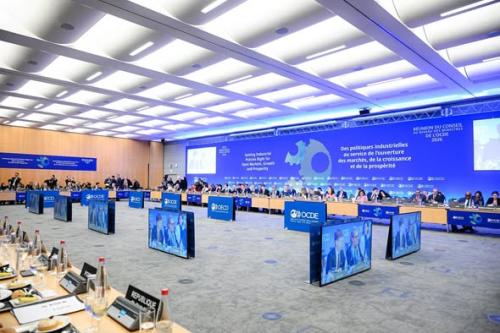









Foreign Affairs Office, The Government Public Relations Department
9 Rama VI Road, Bangkok 10400, Thailand
Tel : (+66) 2618 2323


