


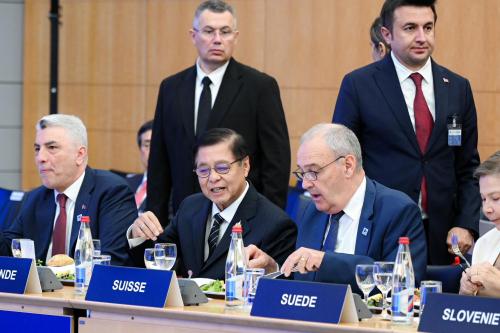
Deputy Prime Minister and Minister of Foreign Affairs of Thailand Sihasak Phuangketkeow on 3 June 2025 delivered a statement at the 2026 OECD Ministerial Council Meeting Session 1: Balancing the Goals and Impacts of Industrial Policy.
In his statement, he said, “For Thailand, industrial policy has been part of our development story. From the 1960s onwards, Thailand pursued a strategy to build domestic industrial capacity. We moved from import substitution to export-oriented policy involving targeted investment incentives, robust FDI strategy and developing local supply chains.
“These policies helped transform Thailand from an agriculture-based economy into one of the region’s manufacturing hubs, especially in automotive industry, electronics, and petrochemical.
“But obviously the domestic and international contexts are changing.
“Today, investors look beyond tax incentives. They prioritize skills, innovation, regulatory quality, ease of doing business, policy continuity, and policy stability.
“At the same time, countries must also create quality jobs, strengthen resilience and advance sustainability alongside growth.
“Industrial policy therefore remains relevant, but its focus must evolve from just supporting individual sectors into enabling economy-wide transitions.
“This means investing in people through skill development and lifelong learning. It means more investment in innovation ecosystems, digital transformation, and green technology.
“And it means strengthening regional integration, as supply chains, technology, energy, and investment increasingly operate across borders. Meanwhile, we must also navigate geopolitical and geo-economic turbulence.
“These are priorities guiding Thailand today as we accelerate reforms, strengthen competitiveness, and build resilience for the future.
“This is why OECD accession matters to Thailand. We see accession not as an end goal, but as part of a broader economic transformation.
“It helps us benchmark against international best practices, improve policy coherence, and strengthen institutions for the future.
“But we also believe that the OECD can benefit from Thailand’s experiences. As an upper-income economy, Thailand also brings practical experiences that can enrich OECD’s discussions and strengthen its engagement with emerging economies.
“In this sense, accession is as much about Thailand learning from the OECD as it is about contributing to the OECD’s growing global relevance, at a time when OECD’s role is evolving.”
 Image
Image 






Foreign Affairs Office, The Government Public Relations Department
9 Rama VI Road, Bangkok 10400, Thailand
Tel : (+66) 2618 2323


