


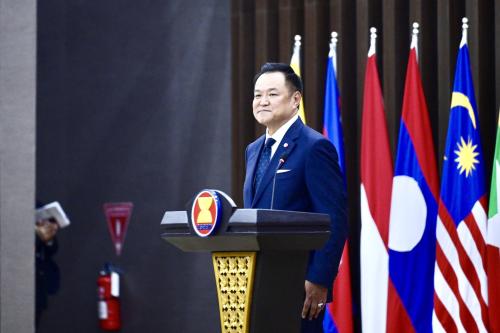
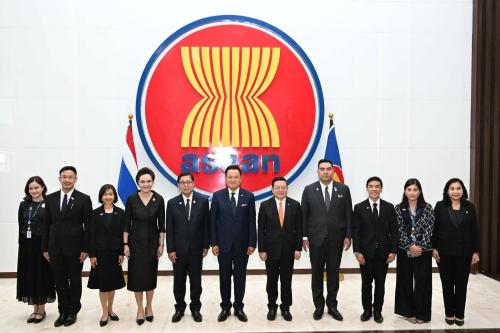
Prime Minister Anutin Charnvirakul on 4 August 2026 visited the ASEAN Secretariat in Jakarta and held a meeting with Secretary-General of ASEAN Kao Kim Hourn. The Prime Minister delivered remarks reaffirming the importance of ASEAN to Thailand and the region, noting that ASEAN is central to Thailand’s foreign policy.
In his statement made at the Nusantara Hall, the Prime Minister said, “I am told that I am the first Thai Prime Minister to speak at the ASEAN Secretariat since Prime Minister Abhisit visited in 2009. Seventeen years is a long interval. But I promise we will not have to wait another seventeen years for the next visit.”
He said, “For Thailand, ASEAN is a regional project we helped begin, and one we remain committed to carrying forward. Indeed, ASEAN was born in Bangkok, this week, 59 years ago. Southeast Asia then was a region marked by conflict, distrust, and rivalry. But our founders came together with a conviction that peace begins when we choose dialogue over division, and cooperation over confrontation. That conviction was the first step that changed our region. Since then, ASEAN has evolved into a rules-based Community. And Thailand was directly involved at many important stages of that evolution.
“It was Thailand who proposed and shaped the creation of the ASEAN Free Trade Area, which laid the foundation for deeper economic integration. The ASEAN Regional Forum was launched in Bangkok in 1994 and has since become an important platform for building trust and advancing dialogue with ASEAN's external partners.
“During Thailand's Chairmanship in 2009, the Terms of Reference for the ASEAN Intergovernmental Commission on Human Rights were also adopted, paving the way for the establishment of this body. And Foreign Minister Sihasak himself was instrumental in shaping that achievement as Chair of the High-Level Panel that drafted the Terms of Reference. These are just some of the milestones that helped transform ASEAN into the community it is today, and into one of the world's success stories of regional cooperation and integration.
“Thailand takes pride in having contributed to that journey. But ASEAN's greatest success lies not only in what we have built, but in our collective resolve to adapt, overcome challenges, and emerge stronger, together. That collective strength has carried ASEAN through political tensions, financial crises, natural disasters, and pandemics. It will be just as important for the road ahead.
“ASEAN now faces a world very different from the one in which it was founded. Today's pressures are more interconnected and reach deeper into our economies and societies. To name but a few, strategic competition now shapes trade, investment, technology, and supply chains. Conflict around a major sea lane can raise energy and food costs across our region. Artificial intelligence can drive growth, but also enable criminal networks to operate faster and across borders.
“These are regional challenges. They demand regional answers. In the face of such challenges, ASEAN must respond with confidence. We must strengthen ourselves from within so that we can withstand pressures from outside. And as we engage the wider world, we must preserve our strategic choices and diversify our options. That means deeper integration, stronger institutions, and wider partnerships. I believe ASEAN now stands at a crossroads. The choices we make today will determine whether ASEAN continues to shape its own future, and remains a trusted and constructive force in the regional and global landscape.”
In his view, the Prime Minister said, “The ASEAN of tomorrow must advance three priorities: stronger regionalism, greater resilience, and lasting relevance.
“First, stronger regionalism. In a fragmented world, ASEAN's unity and centrality matter more than ever. But centrality must be sustained by our ability to manage challenges within our own region. Our principles of consensus and non-interference remain fundamental, but they must be applied with the flexibility and pragmatism needed to preserve unity and enable meaningful action. The issue of Myanmar is a clear test.
“The Five-Point Consensus remains ASEAN's guiding framework. Thailand has advocated a calibrated re-engagement approach that keeps dialogue open and responds to realities on the ground while encouraging concrete progress.
“This approach appears to be moving in the right direction, as yesterday the ICRC was allowed to meet Daw Aung San Suu Kyi, where she appears to be in good health. This has been what Thailand has advocated for all along. We hope to see more positive progress in the near future. A peaceful and stable Myanmar is not only in Thailand's interests as a close neighbor; it is essential to ASEAN's unity and regional stability.
“The same principle applies when differences arise between ASEAN Member States. They must be managed peacefully, in good faith, between the concerned countries. When I met with my Cambodian counterpart in Cebu, we agreed to restore trust and confidence, and give bilateral talks a chance. The compulsory conciliation that Cambodia has initiated runs counter to what we agreed.
“Thailand stands ready to turn a new page with our neighbor. We remain committed to resolving differences peacefully and in accordance with international law, while safeguarding ASEAN's unity and shared regional agenda.
“Second, greater resilience. Resilience is no longer just about recovering from crises. It means making preparations before disruption arrives. ASEAN must deepen integration and strengthen the foundations of our security and prosperity through building trusted supply chains, reliable energy, food security, digital connectivity, and technological capability.
But resilience cannot be built in isolation. ASEAN must widen its partnerships with middle powers and partners across the Global South who share our commitment to an open, inclusive, and rules-based international order. By connecting our strengths and diversifying cooperation, we can create more options, reduce overdependence, and preserve our strategic autonomy. The objective is not to turn inward. It is to remain open from a position of greater strength.
“Third, ensuring relevance. ASEAN's relevance cannot be assumed. It must be earned through being a constructive contributor to regional and global affairs, and, above all, through what we contribute to our people. ASEAN must remain a trusted platform where partners engage constructively and pursue mutually beneficial cooperation. But ultimately, it is our peoples who will judge ASEAN by the results we deliver.
“That means acting together against cross-border threats such as online scams, cybercrime, and human trafficking. It means equipping our young people with the skills and opportunities to shape the region's future. And it means strengthening ASEAN institutions so that decisions become actions.”
The Prime Minister continued, “Thailand has helped ASEAN move forward at defining moments in the past. As ASEAN reaches another crossroads, we stand ready to do so again. We will help build an ASEAN that draws strength from within, stands firm under pressure, preserves its strategic autonomy through wider partnerships, and remains relevant to our peoples and to the world.
“In this way, ASEAN will continue to be an anchor of peace, stability, and prosperity in Southeast Asia, while remaining a trusted and constructive force in the regional and global landscape. This is the future of ASEAN that Thailand believes in.”
 Image
Image 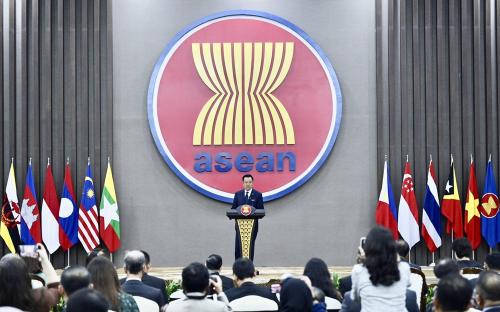




Foreign Affairs Office, The Government Public Relations Department
9 Rama VI Road, Bangkok 10400, Thailand
Tel : (+66) 2618 2323


