


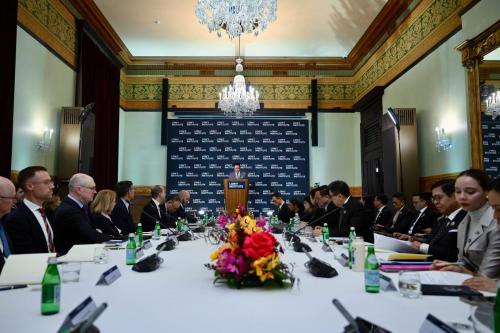
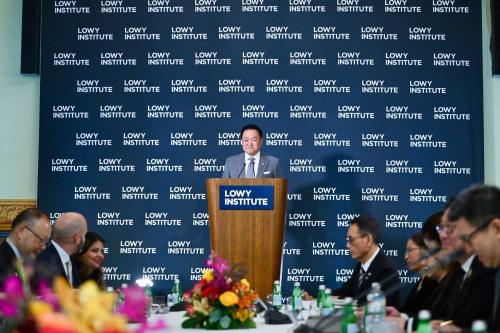
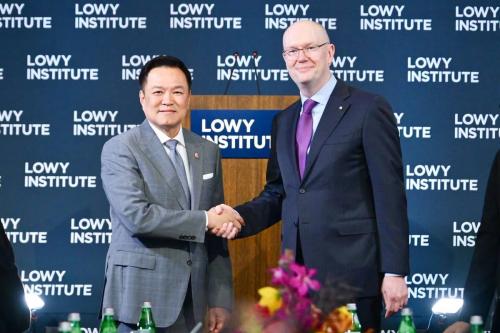
Prime Minister Anutin Charnvirakul on 18 August 2026 delivered a keynote address at the Lowy Institute, Australia’s leading international policy think tank, in Sydney, as part of his official visit to Australia from 17 to 20 August.
In his address “Beyond the Thailand - Australia Bilateral Strategic Partnership: Advancing International Order through Regional and Minilateral Cooperation,” the Prime Minister said, “We are living through a transition in which power is being exercised in new ways. Geopolitics, economics and technology are increasingly intertwined. Strategic competition is reshaping trade, investment and supply chains. Conflicts spread quickly through energy prices, food security and logistical disruptions, as we have seen from the wars in Eastern Europe and the Middle East. The result is a much less predictable international system. We are also seeing interdependence used increasingly as a source of leverage. This erodes trust. Institutions are struggling to keep pace with change. And when rules are applied selectively, countries naturally begin to question the rules themselves.
“For Thailand and Australia, this matters greatly. We both benefit from an international environment that is open, stable and predictable. But a rules-based order cannot be taken for granted. It must be sustained. And that responsibility cannot rest with major powers alone.”
The Prime Minister said that he would offer three answers.
“First, if the global order is under strain, we must make regionalism work. Global institutions remain indispensable. But when consensus is difficult globally, regional institutions must carry more weight. They can keep dialogue open, build trust and translate principles into action.
“For Thailand, this begins with ASEAN, our strategic anchor. ASEAN has helped transform Southeast Asia from a region of division and distrust into one of dialogue, cooperation and growing integration. But ASEAN must also evolve. Its unity and centrality must be sustained by its ability to shape its own agenda and respond effectively to challenges within our region.
“Myanmar is a clear test. Thailand supports the ASEAN Five-Point Consensus, while pursuing calibrated re-engagement that keeps dialogue open and encourages concrete progress. We have recently seen the Myanmar authorities allow an ICRC representative to meet with Aung San Suu Kyi. This is something Thailand has advocated, and we hope it will lead to further progress.
“Our experience with Cambodia offers another lesson. Thailand remains committed to peaceful resolution through dialogue and agreed bilateral mechanisms, while safeguarding ASEAN’s unity. The challenges are different, but the principle is the same: regionalism must help us manage differences while preserving space for cooperation.
"Second, if strategic rivalry is narrowing our policy space, we must preserve strategic autonomy by widening our partnerships. Strategic autonomy does not mean standing apart, nor neutrality on every issue. It means retaining the ability to make our own choices, work with different partners, and judge each issue on its merits. The more constructive relationships we build, the more options we have and the less likely we are to be forced into choices based on the interests of others.
“This is where Thailand and Australia can do more together. As ASEAN’s first Dialogue Partner, Australia has consistently supported ASEAN centrality and an open and inclusive regional architecture. Its engagement through ASEAN, the Mekong-Australia Partnership, and growing economic ties with Southeast Asia demonstrates how sustained engagement can strengthen our regional environment.
“We should complement these efforts with practical, issue-based coalitions. Some call this “minilateralism”. But the label matters less than the result. Cooperation against online scams and transnational crime is one example. Tomorrow in Canberra, Prime Minister Albanese and I will sign a Joint Statement on Cooperation on Transnational Crime, including stronger law-enforcement cooperation. This is how we maintain our agency, not by choosing camps, but by building coalitions that expand our space for cooperation.
“Third, if interdependence is becoming a source of vulnerability, we must build resilience through deeper economic integration. Resilience should mean diversification, not fragmentation. We should reduce excessive dependencies without dismantling the openness that has driven regional prosperity.
“Thailand and Australia already have strong foundations. Our bilateral FTA has been in force since 2005. Two-way trade reached around 32 billion Australian dollars in 2025, while ASEAN–Australia–New Zealand FTA and RCEP connect our economies more widely. The next step is to turn this economic relationship into a resilient partnership. Australia brings strengths in critical minerals, energy, education, technology and capital. Thailand brings advanced manufacturing, food production, regional connectivity and growing green and digital industries.
“We should connect these strengths, from critical minerals to batteries and future mobility; from clean energy to advanced manufacturing; from food security to agricultural technology; and from digital trade to cyber resilience and responsible AI.
“Thailand’s OECD accession will reinforce this direction through stronger standards, regulation, and innovation-led growth. We welcome Australia’s support in this transformation.”
The Prime Minister also said, “We must help build the next order through the choices we make now: regional institutions that can deliver, partnerships that preserve strategic choices, and economic integration that enhances resilience. Thailand and Australia may not determine the balance of global power. But we can help shape how power is exercised in our region. That should be the next chapter of the Thailand – Australia Strategic Partnership: not only strengthening our bilateral relationship, but working together to keep our region rules-based, open, inclusive and resilient.”
 Image
Image 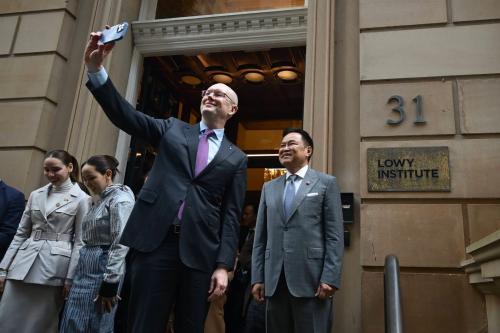




Foreign Affairs Office, The Government Public Relations Department
9 Rama VI Road, Bangkok 10400, Thailand
Tel : (+66) 2618 2323


