


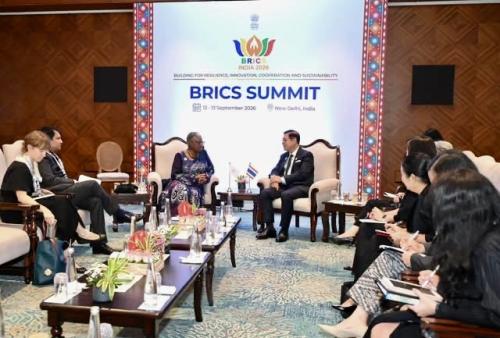
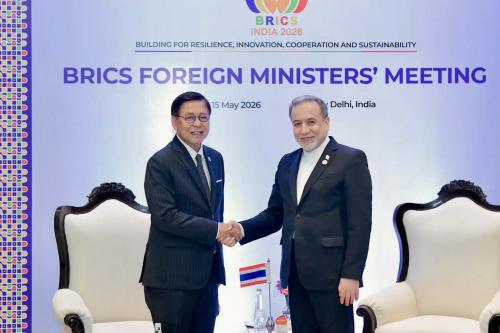
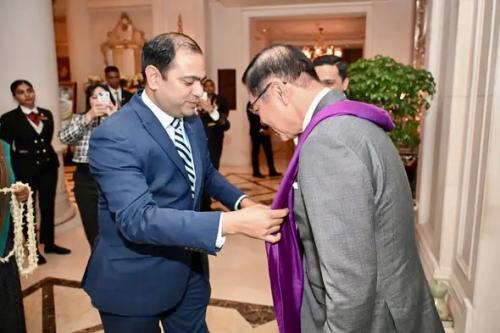
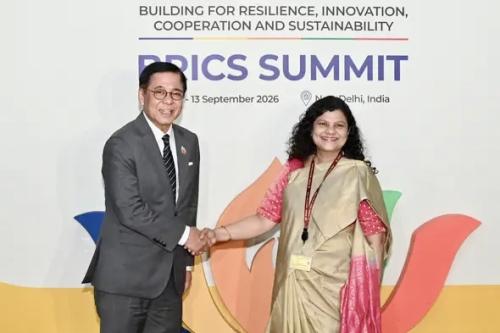
Deputy Prime Minister and Minister of Foreign Affairs Sihasak Phuangketkeow represented the Prime Minister in leading a Thai delegation to attend the 18th BRICS Leaders' Summit 2026 in New Delhi on 12-13 September 2026, at the invitation of Prime Minister of the Republic of India Narendra Modi, in his capacity as BRICS Chair for 2026.
The Deputy Prime Minister delivered a statement in the Session “Resilience, Innovation, Cooperation and Sustainability: Shaping the Future for Inclusive Global Growth” on 13 September, when he understored Thailand's role and readiness to serve as a bridge between BRICS and ASEAN as follows:
“Thailand congratulates India on its chairmanship and BRICS on two decades of cooperation. As we all have underscored this morning, the world is facing many challenges and disruptions that test both our countries’ resilience and the rules-based international order we have long relied on. This makes it all the more important for the Global South to come together.
“Together, we can indeed make a difference. Our economies are increasingly driving global growth. And by working together, we can strengthen resilience and ensure our voice in global decisions is heard and heeded in shaping the international order in a multipolar world.
“BRICS can help turn our collective strength into influence and action, giving the Global South a greater say and helping us build the capacity to respond together.
“That is why Thailand values its partnership with BRICS as a platform to deepen ties and work together on common challenges across the Global South.
“Our cooperation to strengthen countries’ ability to manage risks, adapt to change and share benefits for growth. Indeed, we have made progress, still much more remains to be done, especially in trade and investment, cooperation in new technology, AI and financial transactions, issues that we all have touched upon this morning.
“This is also the principle behind Thailand’s approach to South-South Cooperation: practical partnerships that build resilience and make development more inclusive.
“Our Thailand–Africa Initiative puts this approach into practice. During my recent visit to Nigeria and Ethiopia last month, we explored how Thailand can support development needs through development cooperation, trade and investment.
“Our approach is to combine technical know-how, development cooperation and business partnership to support growth and resilience, in ways that respond to the priorities of local communities.
“That is how Thailand seeks to contribute, and an approach we can help develop together across the Global South.
“Importantly, that same spirit of cooperation must guide how we manage risks that no country can tackle alone, from online scams to climate change.
“Last year, global financial losses from scams exceeded 422 billion US dollars, while seven in ten adults worldwide reported having encountered online scams in one way or another. Last year, Thailand helped repatriate tens of thousands of victims, and we have launched a Global Partnership against Online Scams to strengthen international cooperation against these networks.
“Climate resilience is another shared challenge. Thailand supports wider access to green finance, including through the New Development Bank, so countries can build resilience without holding back development.
“Challenges like this show why multilateralism and regionalism are mutually reinforcing. Many cross-border problems cannot be solved by countries acting alone. Regional frameworks allow us to combine strengths, coordinate responses and act together.
“For Thailand, in our own region, ASEAN provides that foundation. But we also see scope for closer ASEAN–BRICS cooperation, particularly on food security, supply chain and the digital economy.
“By connecting our regions, ASEAN and BRICS can widen cooperation, strengthen resilience and amplify the Global South’s collective voice. And Thailand stands ready to play our part.”
 Image
Image 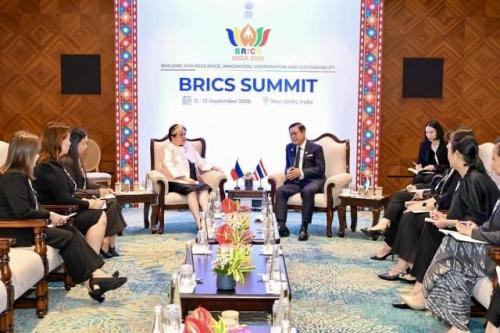





Foreign Affairs Office, The Government Public Relations Department
9 Rama VI Road, Bangkok 10400, Thailand
Tel : (+66) 2618 2323


