
Jirayu Huangsap, Government Spokesperson, has unveiled the key outcomes of the Extraordinary Thailand-Cambodia General Border Committee (GBC) Meeting held on 7 August 2025 in Kuala Lumpur, Malaysia. The Thai delegation was led by Nattaphon Narkphanit, Deputy Defense Minister. The meeting was observed by representatives from Malaysia, China, and the United States.
This meeting was convened as a follow-up to the Special Meeting held on 28 July 2025 in Putrajaya, Malaysia. Both sides had agreed to a ceasefire, but Cambodian forces continued to violate the agreement, including the dissemination of disinformation and the use of drones for surveillance. Thailand’s objective in the GBC meeting was to find ways to continue the ceasefire and bring peace to the borders.
Regarding the key outcomes of the GBC meeting, both sides agreed on the following points:
1. Cease use of all types of weapons and maintain current status of troop deployments, as in effect since 28 July 2025, without further movement;
2. Establish an interim observer team, led by Malaysia, consisting of defense attachés from ASEAN member countries who are accredited to Thailand and Cambodia; the attachés will independently observe the implementation of the ceasefire on the side to which they are accredited;
3. Refrain from provocative actions that may escalate tensions, both military activities and fake news dissemination;
4. Comply with the Geneva Conventions: Captured soldiers will be immediately released after the conflict ends, and the two sides will facilitate the dignified return of the deceased;
5. Convene the Regional Border Committee (RBC) Meeting within two weeks after this Extraordinary GBC Meeting; also, the next GBC Meeting is scheduled within one month after 7 August 2025 to follow up the implementation of the ceasefire.
However, there were two other important issues raised by Thailand but that have not yet been accepted by Cambodia and will be proposed to the next GBC meeting:
1. Cooperate in landmine clearance operations in recent conflict areas;
2. Collaborate on tackling transnational crime, especially online scams.
 Image
Image 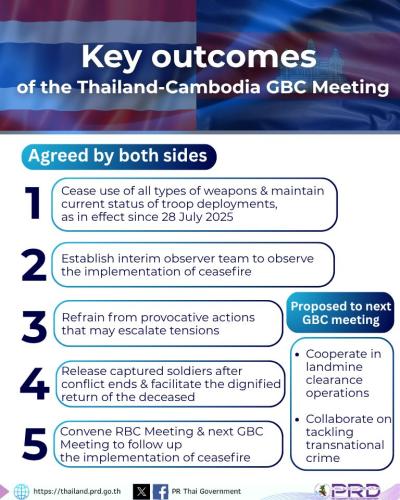



Foreign Affairs Office, The Government Public Relations Department
9 Rama VI Road, Bangkok 10400, Thailand
Tel : (+66) 2618 2323


