
Thailand has reiterated its call on the international community to do what as much as possible to bring Cambodia back to full compliance with the Anti-Personnel Mine Ban Convention (Ottawa Convention).
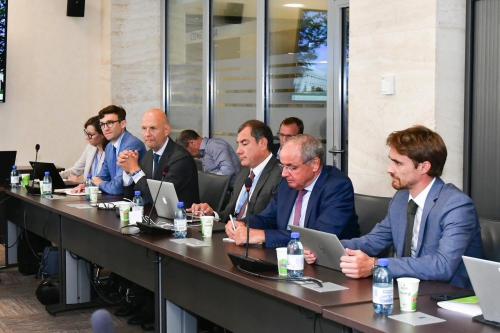
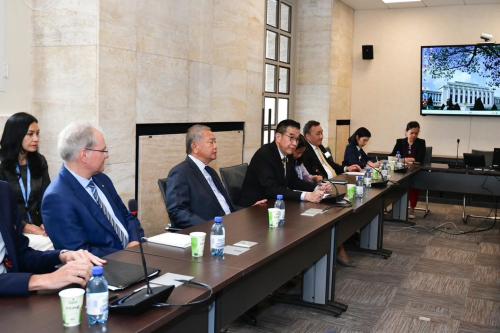
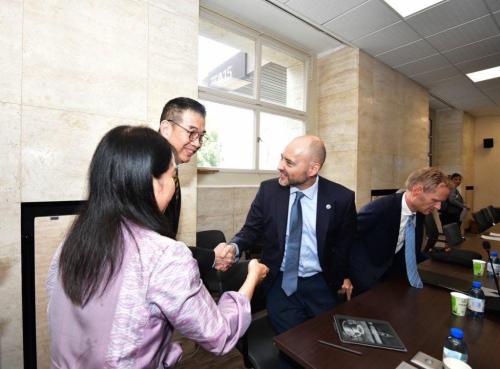
The call was made by Minister of Foreign Affairs of Thailand Maris Sangiampongsa at the Meeting with Relevant Parties and Stakeholders under the Anti-Personnel Mine Ban Convention at the United Nations Headquarters in Geneva on 27 August 2025.
In his remarks, Foreign Minister Maris stated that, as a strong believer and active advocate for humanitarian disarmament, Thailand is fully committed to implementing its obligations under the Ottawa Convention. It has always played an active role within the framework of the Convention – to save lives, protect human dignity, and support mine victims in their recovery and integration to society.
He said, “To date, we have cleared over 99 percent of mine-contaminated areas, covering some 2,500 square kilometers – turning them into “safe spaces”, restoring livelihoods for our communities. These efforts have been recognized by the international community, including by the President of the ICRC at the HRH Princess Maha Chakri Sirindhorn Lecture on International Humanitarian Law in Bangkok last week, who commended Thailand for ‘reducing the human cost of mines from 350 casualties between 1999 and 2000 to just 24 in 2011.’ And in 2024, we recorded zero deaths and three injuries from landmines in Thailand.
“We have cleared all landmines along our borders with Malaysia, Myanmar, and Lao PDR. The remaining 12.8 square kilometers of landmine contaminated area is along the border with Cambodia. This is why Thailand has, for a long time, been pursuing humanitarian demining cooperation with Cambodia.”
Foreign Minister Maris said that it was regrettable that Thailand was confronted with the current situation at the Thailand-Cambodia border – one that Thailand neither sought nor stands to benefit from in any way.
He said, “it began on 16 July, when a Thai solider lost a leg to a landmine during a routine patrol in the Chong Bok area of Ubon Ratchathani Province. Several more landmines were discovered near the incident site, with clearly visible factory markings, and no signs of vegetation or rooting, indicating that they were newly planted. And we have collected more than enough evidence that can be proved beyond any reasonable doubt that all these landmines were indeed planted just recently. These were PMN-2 type mines – which is in possession of Cambodia, according to its own transparency report, whereas Thailand no longer has landmines of any type in our stockpile.
“Exactly one week later, on 23 July – another incident occurred. I remember it vividly as I was in New York – about to meet the Secretary-General. I informed him of the situation and Thailand’s condemnation of Cambodia’s inhumane actions, and the peaceful measures we were taking to address this issue.
“The turning point came the very next day, 24 July, when Cambodia launched cross-border attacks at Ta Muen Tom in Surin Province, followed by heavy artillery, including BM-21 multiple rocket launchers into Thai civilian communities, striking schools, hospitals and convenient store—killing innocent civilians, including children.
“Thailand responded in necessary and proportionate self-defense, limited in scope and strictly aiming at military targets, in full respect of international law, the UN Charter, and international humanitarian law. The attack continued even after a ceasefire was reached on 28 July in Putrajaya through the good offices of Malaysia, in its capacity as ASEAN Chair—a ceasefire that Cambodia broke.
“Later, both sides met again at the Extraordinary General Border Committee (GBC) Meeting in Kuala Lumpur and agreed to a ceasefire covering all types of weapons, including landmines—an agreement that Thailand fully respects and is firmly committed to. Yet, less than five days later, three additional landmine incidents occurred on 9 and 12 August, and the latest, this afternoon.
“To date, these landmine attacks have caused permanent disability to six Thai soldiers. Newly planted and unused PMN-2 mines were also discovered, together with evidence that Cambodian soldiers had been trained to lay such mines – clearly indicating that these mines were planted by Cambodia. These acts constitute a serious violation of the sovereignty and territorial integrity of Thailand, and of the Ottawa Convention – in breach of the ceasefire agreement.”
Foreign Minister Maris also announced that Thailand would join the United Nations Secretary-General’s Global Advocacy Campaign on Humanitarian Disarmament and Mine Action, reflecting Thailand’s long-standing commitment not only to the Ottawa Convention but also to humanitarian disarmament and international humanitarian law.
He said, “Through this Campaign, Thailand will do what we can to promote mine action, which is about saving lives, protecting dignity, safeguarding human rights and advancing development and the well-being of our peoples and communities.
“Thailand stands ready to work with the United Nations and all partners toward the noble objective of the Convention - to achieve a mine-free world for the present and future generations.”
 Image
Image 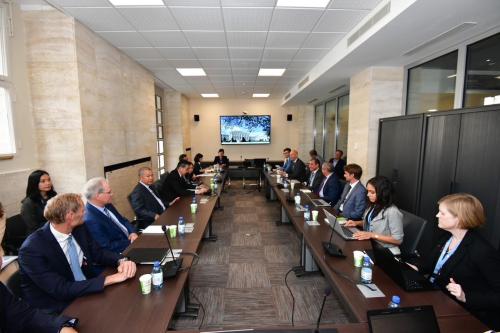




Foreign Affairs Office, The Government Public Relations Department
9 Rama VI Road, Bangkok 10400, Thailand
Tel : (+66) 2618 2323


