


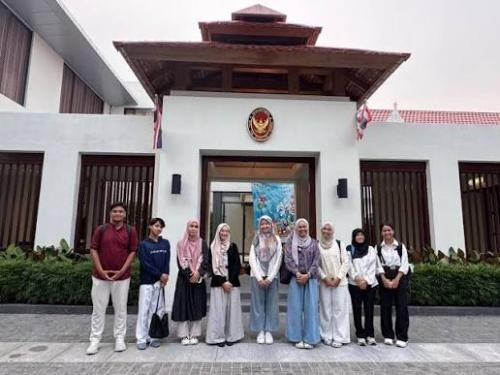
Six youth representatives from the southern border provinces recently visited Penang, Malaysia, to enhance understanding of multiculturalism through the “Penang Model.” The visit was led by officials from the Ministry of Foreign Affairs of Thailand.
According to a report from the Ministry of Foreign Affairs, the youth representatives met members of government agencies that play key roles in supporting initiatives to promote Penang’s multicultural society. They also studied the city’s urban landscape and planning, which reflect its religious and cultural diversity.
On this occasion, the delegation met Mr. Psusist Wongsurawat, Consul-General of Thailand to Penang, for a briefing on the history of Penang’s multiculturalism, and visited (1) the Malaysian Ministry of Tourism, Arts and Culture, Penang Office, (2) Tourism Malaysia, (3) Penang Global Tourism, (4) Penang State Executive Councilor for Tourism, Arts, Culture and Heritage, and (5) Penang State Executive Councilor for Social Development, Welfare and Non-Islamic Affairs.
The visits and meetings provided opportunities for the youth representatives to enhance understanding and exchange views on Penang’s model of multiculturalism (“cultural mosaic”), as characterized by the harmonious coexistence of diverse cultural, ethnic, racial, religious, and language backgrounds.
They also learned about the roles of government agencies in constructing and representing multiculturalism, while establishing mechanisms to promote participation and constructive interaction among all sectors of society.
In addition, the delegation also visited key cultural sites in Penang that reflect the concept of peaceful coexistence in a multicultural society, particularly along Jalan Masjid Kapitan Keling, also known as the “Street of Harmony,” where places of worship of different religions are located, such as St. George’s Anglican Church, the Goddess of Mercy Temple, the Kapitan Keling Mosque, and the Sri Mahamariamman Temple.
The delegation expressed interest and exchanged views on multicultural society in the southern border provinces of Thailand, while experiencing first-hand knowledge on multicultural society in Penang. This would be beneficial for the future development of harmonious co-existence of the people in the deep South of Thailand, the land of cultural diversity.
 Image
Image 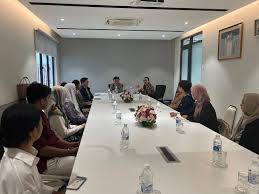



Foreign Affairs Office, The Government Public Relations Department
9 Rama VI Road, Bangkok 10400, Thailand
Tel : (+66) 2618 2323


